Most lenders know their LTV at origination. Far fewer know it right now.
LTV and LTGDV shift as loans draw down and valuations age. kennek tracks LTV distribution live across your whole book, so breaches surface early.
Senior Vice President, Product Management
- Published
- Reading time
- 1 min read
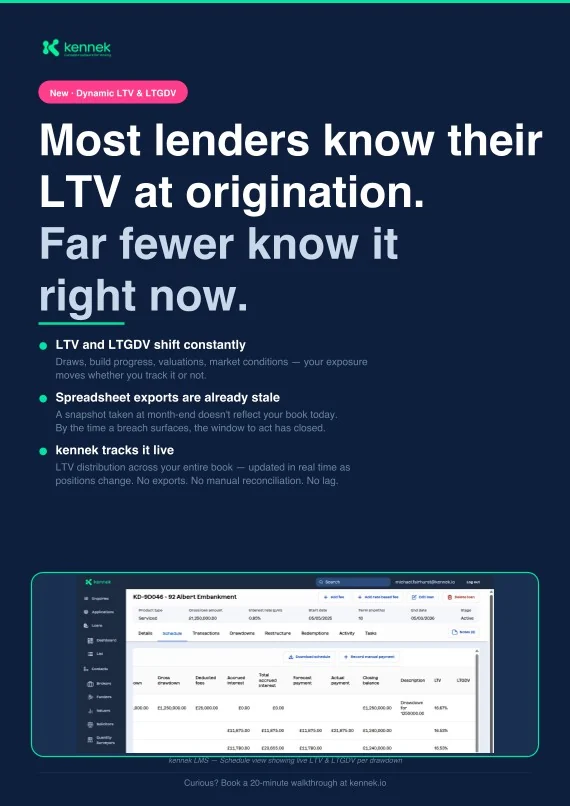
In bridging and development finance, LTV and LTGDV aren't static numbers. They shift as loans are drawn down, properties are developed, valuations age, and market conditions move.
Yet most teams are still tracking exposure through spreadsheet exports — a snapshot of a position that changed the moment it was taken.
The risk isn't just operational. It's strategic. By the time a breach surfaces in a quarterly review, the opportunity to act early has already passed.
That's why we built live LTV distribution tracking into kennek — a view of where your LTV exposure sits across your entire book, updated in real time as positions change.
When your LTV distribution is always live, your team can spot concentrations before they become problems, respond to breaches the moment they occur, and walk into credit committee with data that's current — not last Tuesday's.
For development lenders, that means LTGDV tracked against actual build progress, not a fixed point-in-time assumption.
For bridging lenders, it means knowing exactly where your book sits relative to appetite.
Risk management isn't just about the numbers. It's about how quickly you can see them.
See how kennek tracks LTV distribution live across your book.
Originally posted on kennek's LinkedIn.
- Bridging finance
- Development finance
- Risk management